
Direct Entry Students: Catching Up to 200L Coursework
Entering a Nigerian university through Direct Entry? Learn how to bridge 100L gaps, manage borrowed GST course clashes, and secure a First Class CGPA in 200 Level.

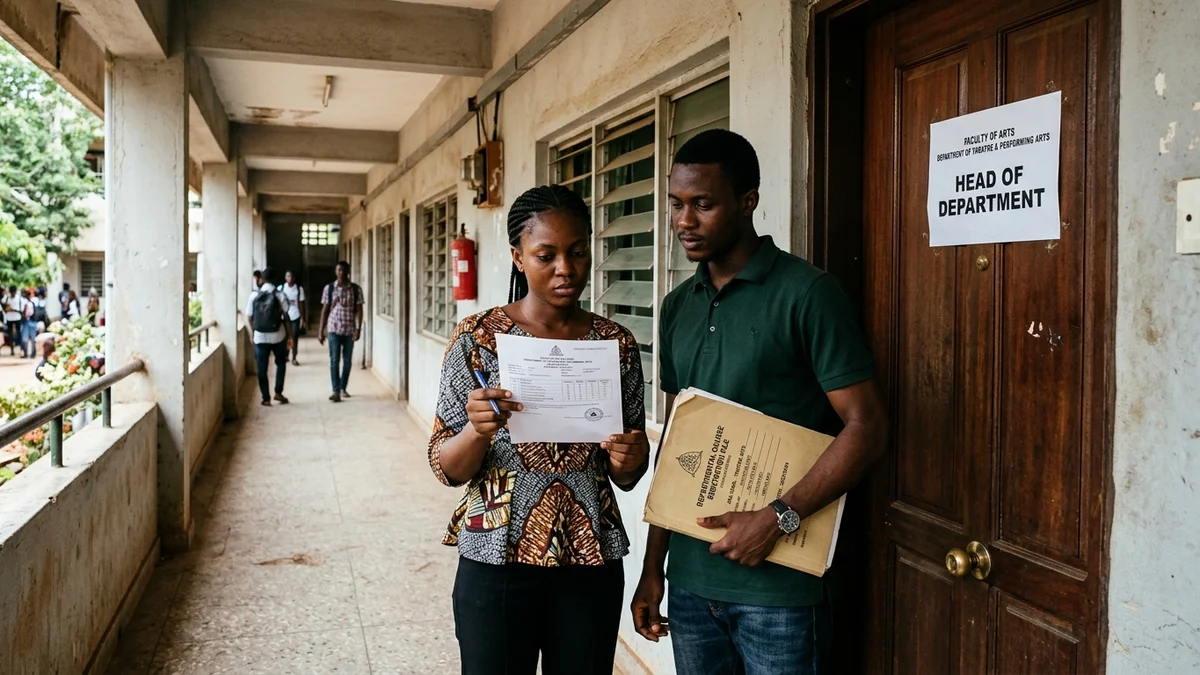
You arrive on campus with your JAMB Direct Entry admission letter tucked neatly inside a plastic folder.
You earned an Upper Credit in your National Diploma (ND) from a federal polytechnic, completed an intensive JUPEB program, or passed your IJMB exams with 13 points. You feel academically mature. You bypassed the chaotic 100 Level "Jambite" phase entirely, stepping straight into 200 Level.
Senior students and coursemates congratulate you on saving a whole year.
Then reality strikes like a physical blow.
It is already Week 7 of the semester. Because university admissions offices notoriously release Direct Entry lists months after regular students have resumed, your coursemates have already completed six weeks of lectures.
They have submitted continuous assessment assignments, formed laboratory bench groups, and know every lecturer’s quirks. Meanwhile, you don't yet have an official matriculation number, your student portal profile is still unverified, and you have two mid-semester tests scheduled for next Tuesday.
To make matters worse, your departmental Course Level Adviser hands you your registration sheet: you must register 24 credit units—including tough 200-level departmental core courses and three compulsory, backlog 100-level General Studies (GST) papers.
Welcome to the Direct Entry Academic Trap.
In Nigerian universities governed by National Universities Commission (NUC) guidelines, Direct Entry students face unique structural hurdles that can dismantle even the most disciplined polytechnic graduate.
Here is why the 200 Level transition is so treacherous for Direct Entry students, and the exact operational blueprint to catch up, eliminate timetable clashes, and graduate with a First Class or Second Class Upper.
1. The 4 Hidden Structural Traps Facing DE Students
The academic struggle of Direct Entry candidates is not an intelligence deficit; it is an administrative and structural handicap:
- **Late Arrival Shock:** Resuming in Week 6–8
- **The Borrowed Course Burden:** 100L GST Backlog
- **The Short Denominator Problem:** 6 Semesters, Zero Cushion
- **Pedagogical Culture Shock:** Polytechnic Hands-on ➔ University Pure Theory
1. The Late Admission Penalty
While UTME freshers begin classes in Week 1, Direct Entry lists often trickle out in the middle of the semester. Missing the first 40% of lectures means entering the course when lecturers are teaching advanced, derived concepts that build on earlier unread foundations.
2. The Compressed CGPA Denominator
This is the single most dangerous mathematical trap. A standard 4-year UTME student has 8 semesters (around 160 credit units) to average their performance. A Direct Entry student has only 6 semesters (around 120 credit units).
If a UTME student struggles in 100 Level with a 2.50 GPA, they have seven semesters to dilute that poor start. If a Direct Entry student slips to a 2.20 in 200 Level First Semester, there are simply not enough remaining credit units to pull that grade into a First Class.
To understand the mathematical mechanics of cumulative grade points on the Nigerian scale, review our master guide on understanding CGPA calculation on the NUC 5.0 scale.
3. The 100L GST Timetable Collision
Senate regulations mandate that all graduates must pass national General Studies courses (such as GST 111 Communication in English, GST 112 Nigerian Peoples and Culture, and GST 113 Philosophy & Logic).
Because you are taking 100-level courses while enrolled in 200 Level, your lecture timetables will inevitably collide: an essential 2-hour 200L Thermodynamics lecture scheduled at the exact same hour as a compulsory 100L GST test.
4. The Culture Shock: Applied Practice vs. Abstract Derivations
Polytechnics and diploma programs excel at practical, applied technical execution. Nigerian federal universities, however, prioritize mathematical derivations from first principles, theoretical proofs, and dense textbook literature. A polytechnic graduate who knows how to operate an industrial lathe may struggle when asked to mathematically derive the stress tensor equation on an exam script.
To bridge the difference in learning styles between vocational and university models, review our guide on polytechnic vs university study habits.
2. Phase 1 (First 72 Hours): The Foundational Audit
Do not start by reading 200-level handouts blindly. The lecturers standing in front of you assume you took their specific 100-level prerequisite courses last year.
- Connect with Course Rep] ➔ [Acquire 100L Departmental Handouts] ➔ [Map Divergent Notation
The 72-Hour Rapid Catch-Up:
- **Identify the Departmental Course Rep:** Introduce yourself immediately. Request the soft-copy slides and handouts from the previous session's 100L core papers (e.g., MTH 101/102, PHY 101/102, or introductory Law/Economics).
- **Conduct a Notation & Syllabus Audit:** Compare the university’s 100L syllabus with what you covered in your ND or A-Level program. Note differences in mathematical notation, terminology, and standard textbooks.
- **Form a "UTME Buddy" Alliance:** Pair up with a high-performing 200-level student who completed 100L in the institution. They understand which topics the lecturer obsessively emphasizes and which past questions are recycled every semester.
If you are unfamiliar with the lecture styles and amphitheater dynamics of federal universities, read 100 level Jambite transition and academic shock.
3. Phase 2: Resolving the 100L/200L Lecture Timetable Clash
When a 100L GST lecture clashes with a 200L core departmental course, never skip your 200L core departmental lecture.
| Course Type | Credit Units | Impact on Degree | Attendance Strategy |
|---|---|---|---|
| 200L Core Departmental | 3 or 4 Units | Core Prerequisite (Carryover Risk) | 100% Mandatory In-Person Attendance |
| 100L GST Elective | 1 or 2 Units | General Senate Requirement | Delegate / Study Pod Partnership |
The GST Delegate Protocol:
- Find a reliable 100-level student in your faculty.
- Request that they notify you of any unannounced continuous assessment tests or attendance sheets.
- Form a study group with fellow Direct Entry coursemates taking the same GST backlog. Divide the reading materials and share consolidated active-recall summaries.
4. Phase 3: The Continuous Assessment (CA) Recovery Sprint
Because you resumed late, you may discover that your class has already taken an unannounced Continuous Assessment test or submitted a graded term paper.
Do not accept a 0/30 mark.
How to Approach Course Lecturers:
- Take your stamped **JAMB Direct Entry Admission Letter** and your official faculty clearance slip.
- Approach the course lecturer during scheduled office consultation hours.
- Present your documentation calmly and professionally:
*"Good afternoon, Dr. [Lecturer Name]. I was admitted through the JAMB Direct Entry quota and completed my official faculty clearance this week. I understand that the class took a 15-mark continuous assessment test in Week 4 while my admission was processing. Here are my admission documents. May I respectfully request an alternative assignment or make-up assessment so I can earn my continuous assessment marks?"*
Under university Senate guidelines, lecturers are administratively encouraged to accommodate late-matriculating Direct Entry students with alternative assignments, makeup quizzes, or oral assessments.
5. The 200 Level Examination Execution Blueprint
When exam timetable drafts are published, Direct Entry students often find themselves writing seven or eight papers across two weeks due to backlog courses.
To survive and excel:
- **Focus on 5-Year Past Questions:** In Nigerian universities, 70% of 200L exam questions are variations of previous departmental examination papers. Reverse-engineer marking rubrics starting in Week 8.
- **Master Written Derivations:** Do not just read formulas; practice writing out full proofs and derivations with a blue biro on blank lined paper under timed conditions.
- **Protect Your Sleep:** Never pull consecutive "Till Daybreak" (TDB) all-nighters. Cognitive sleep deprivation destroys working memory retrieval, wiping out weeks of hard catch-up study.
The Direct Entry First-Semester Checklist
Follow this systematic roadmap from your first day on campus:
- **Complete faculty and departmental clearance immediately:** Secure your student portal login within 48 hours.
- **Audit the 100-level prerequisite handouts:** Identify notation and syllabus differences between your diploma and the university syllabus.
- **Request make-up CA tests for missed assessments:** Present your official admission letter to course lecturers during office hours.
- **Form a partnership with a top-performing UTME 200L peer:** Share notes, past questions, and lecturer insights.
- **Prioritize 200L core departmental courses:** Prevent carryovers in heavy 3-unit and 4-unit prerequisite papers.
Build an Unstoppable Academic Comeback
Direct Entry is an incredible opportunity to accelerate your degree, but it leaves zero margin for trial and error. To secure the First Class or 2:1 honours you deserve, you need an engineered study system.
The Academic Comeback Package
A complete 7-part digital system created specifically for Nigerian university students ready to eliminate exam anxiety, master complex coursework, and produce peak academic performance.
- Get Good at Hard Things — Cognitive protocols to master difficult math, engineering, and theoretical coursework
- How to Score High in Any Exam — Reverse-engineer Nigerian lecturers' marking rubrics and pass criteria
- 30-Day Study Tracker — Pre-built templates to organize heavy multi-level course loads and revision sprints
Frequently Asked Questions
Why do Direct Entry students find 200 Level so academically overwhelming?
Direct Entry (DE) students usually arrive on campus weeks late due to delayed admission lists, missing early Continuous Assessment tests. Furthermore, they must juggle heavy 200-level core courses alongside compulsory 100-level General Studies (GST) prerequisites, all without the mathematical cushion of a 100-level CGPA.
Do 100 Level courses count in a Direct Entry student's CGPA in Nigeria?
No. Your previous polytechnic ND, JUPEB, or IJMB grades do not carry into your university transcript. However, any compulsory 100-level university courses you are required to take (such as GST 111 or faculty prerequisites) count directly toward your university CGPA and credit denominator.
How does having a 3-year degree affect a Direct Entry student's CGPA strategy?
Regular UTME students have 8 to 10 semesters to build and buffer their CGPA. Direct Entry students only have 6 semesters (in a 4-year degree). A poor 200-level first semester (e.g., 2.30 GPA) leaves very few remaining credit units to pull your final degree class up to a First Class or 2:1.
What is the best way to handle timetable clashes between 100L GSTs and 200L core lectures?
Always prioritize core departmental prerequisite lectures in person, and form a study partnership with a reliable 100-level student to secure GST attendance sign-ins, assignment briefs, and test schedules. Inform both course lecturers in writing through your Level Adviser.
What Did You Like Most About This Guide?
Share your favorite takeaway, a study technique you tested, or ask a question.